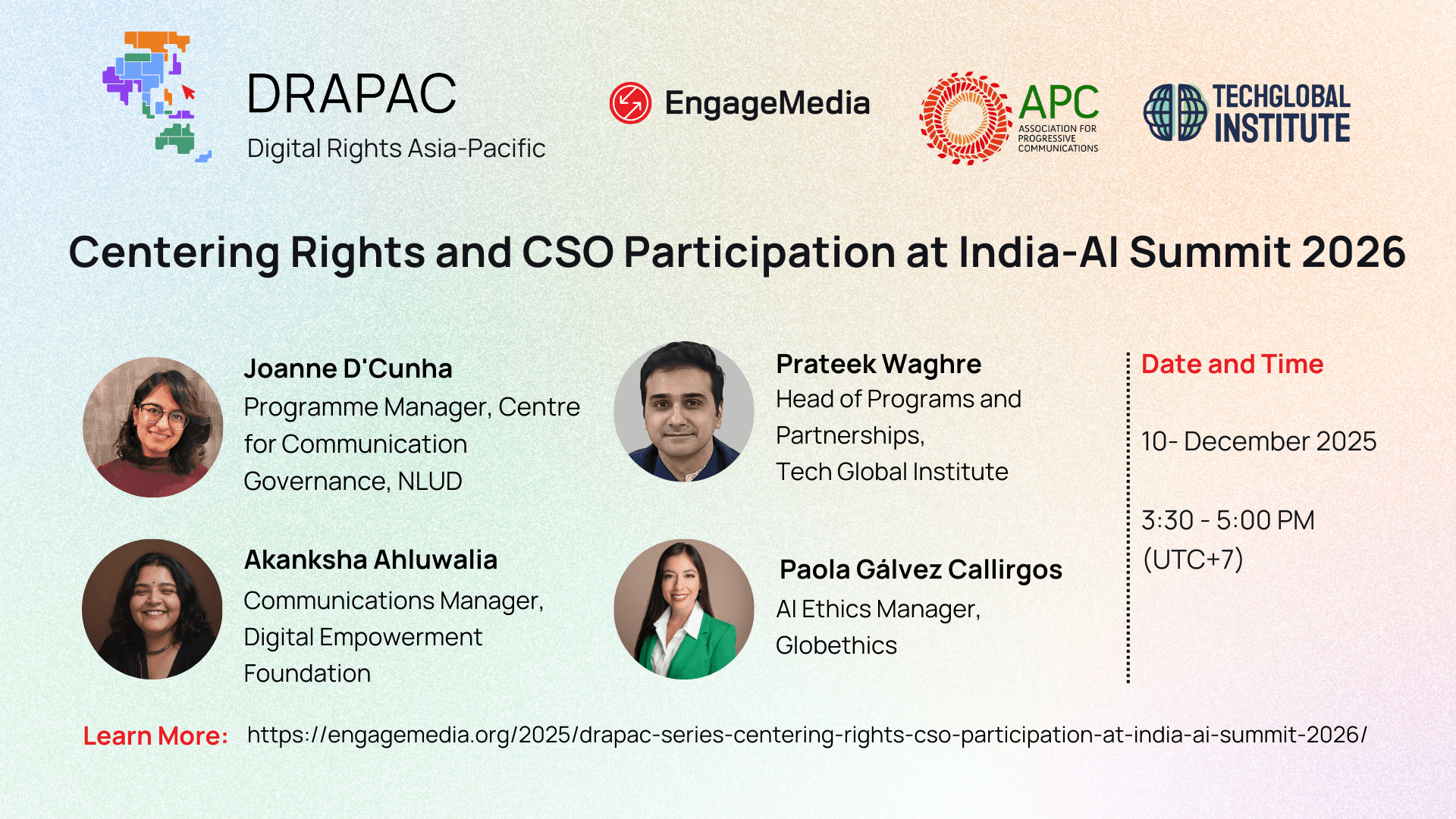
Note: Registration is now required to join the conversation.
Date and Time: December 10, 3:30 PM – 5:00 PM Bangkok time (UTC+7)
Room: Zoom (to be emailed to registrants prior to the event)
Description:
The upcoming India–AI Impact Summit 2026 has put forth seven “chakras” or themes for global participation, including the advancement of AI systems that “are inclusive by design, empowering diverse communities and ensuring equitable representation”.
The summit is shaping into a critical forum for highlighting AI risks and opportunities and influencing key initiatives around AI governance processes. Civil society actors play a crucial role in these discussions, surfacing underrepresented issues and the voices of communities most impacted by the greatest risks of AI.
This learning call aims to center rights and civil society participation at the summit by analysing the seven themes for participation, identifying critical issues currently absent from ongoing conversations, and exploring meaningful entry points for civil society to engage further in these global initiatives.
Guest speakers:
Prateek Waghre is the Head of Programs and Partnerships at the Tech Global Institute. A technologist-turned-public policy researcher, he is also a fellow at Tech Policy Press. Prateek was previously the Executive Director at the Internet Freedom Foundation, India, and a researcher at The Takshashila Institution. Prateek is an alumnus of the ‘International Visitor Leadership Program’ (IVLP) representing India for a programme on combating and identifying disinformation. Prateek is deeply interested in how technologies and their deployment affect liberal democratic societies and spaces, and technology policy developments in India.
Joanne D’Cunha is a Programme Manager with the Centre for Communication Governance at the National Law University Delhi. Her work focuses on examining emerging technologies such as AI, platform design and harms, and privacy and data governance, towards designing effective legal and policy pathways. She’s deeply interested in investigating data control and power asymmetries and their implications on society. Joanne has previously been a researcher with Tandem Research and Associate Counsel for Policy, Parliamentary and Regulatory affairs with the Internet Freedom Foundation.
Paola Gálvez Callirgos is a Global AI Governance & Tech Policy Expert with vast experience advancing human-centric digital governance across the private sector, government, and multilateral organizations. She holds a Master of Public Policy from the University of Oxford and her contributions have shaped national and international AI strategies, influencing regulatory frameworks and capacity-building initiatives. Paola is AI Ethics Manager at Globethics and has been appointed as expert member of two distinguished UNESCO networks, AI Ethics Experts Without Borders and Women for Ethical AI. She also serves as Steering Committee Member and trainer at the UN Women AI School and AI Policy Fellow at the Center for AI and Digital Policy.
Akanksha Ahluwalia leads the Social Inclusion, Media & Information Literacy (MIL), and communication-driven programmes at the Digital Empowerment Foundation (DEF), India. With a background in English Literature and a focus on gender, misinformation, and new media, she brings a nuanced lens to the evolving challenges of digital communication in underserved regions.
Resource/s: