The Center for Independent Journalism (CIJ), EngageMedia, Oxfam, and Wikimedia Foundation, together co-convened a Multi-Stakeholder Dialogue on Artificial Intelligence (AI) Governance and Accountability in Indonesia and Malaysia. The dialogue was held as a part of the Digital Rights Asia Pacific Assembly 2025 (DRAPAC25) held last August in Kuala Lumpur, Malaysia.
The event invited Mr. Darmain Segaran, Manager of AI Policy from the Malaysia National AI Office (NAIO) and Mr. Henke Yunkins of the Indonesian AI Taskforce to present and discuss the current state of AI governance in both states and potential avenues of collaboration between the two countries and the greater ASEAN region. The multi-stakeholder dialogue also engaged a cohort of civil society, international organisations, and academia from Indonesia, Malaysia, and Southeast Asia.

The consultation opened with representatives of Indonesia and Malaysia elaborating on the steps their countries have undertaken related to AI governance and accountability.
Mr. Darmain of NAIO highlighted NAIO’s seven deliverables as part of its mandate, including the launch of a national roadmap and a regulatory framework expected to be launched by September 2025. NAIO – which functions as a centralised office – is focusing on policy development, guidelines, and code of conduct for AI procurement, development, and deployment in Malaysia. The institution emphasises innovation and adoption of the technology, and has developed sectoral approaches to AI integration in specific fields, such as Dr. MATA in the medical field and AI Rakan Tani for the field of farming and crop production.
Mr. Yunkins elaborated that the Indonesian AI Task Force under the Minister of Digital and Communications has launched the draft White Paper and Ethics Guideline for Indonesian AI Governance in early August 2025, and that the paper was an expansion of the AI National Strategy released in 2020. Mr. Yunkins shared that the task force views AI as part of a larger tool—much like other tools that preceded the technology—and its implementation should not be an end goal but rather as a means to an end. He highlighted the importance of a bilateral engagement between Indonesia and Malaysia, as well as the need to foster regional collaboration facilitated by ASEAN.
Under the consultation, we highlighted several key feedback on the status of AI Governance in both countries and the greater region. These were delivered by representatives of civil society, international organisations, and AI experts:
- Data Governance as the basis for AI Governance. It is crucial to build the discourse of AI Governance and/or AI Policies with data protection and data governance as its central foundation. Data protection is critical due to AI’s reliance on large datasets, raising issues like privacy, discrimination, and surveillance.
- Human Rights, Consumer Protections, and Ethical Practices. States hold significant authority over AI, including over procurement, implementation, and regulation. States should exercise these three responsibilities in accordance with human rights principles. Considerations on ethical practices and consumer rights are also essential, particularly in relation to bias and automated content that may perpetuate prejudices. Community interests and efforts to bridge the digital divide should be prioritised.
- Basic requirement for AI Governance. Transparency and accountability in AI decision-making are vital for stakeholder trust. Standardised metadata, evaluation, and labelling systems for AI data and usage should be made necessary in order to measure these goals. Furthermore, redressal mechanisms should be available for grievances involving both the private sector and the government, one avenue of which may be catered under the consumer protection law.
- The problem with data centers. Conflicts arise over data centre siting, particularly during crises such as droughts, where household needs must be balanced against the resource demands of data centres. Promises of economic benefits from data centres remain unfulfilled, highlighting the need to carefully assess their social impacts.
Responding to these highlights, CSOs have come up with a six-point recommendation for plans to address AI adoption.
- Transparency & Accountability: AI systems should be made transparent, with disclosure to users in the use of these systems in critical areas; an accountability mechanism must also be set out
- Privacy and security by design: There should be human oversight for decision-making.
- Independent institution: An independent institution that serves as an oversight body will contribute towards upholding accountability in the use of AI systems.
- Addressing risks: Specific attention on oversight and safeguards should be made to tackle the risks of data colonization and risks to decent work/labour, which have been found to occur in Malaysia: a risk assessment must be conducted.
- Redressal mechanism: The government should create a litigation pathway that establishes clear guidelines & liability for AI-generated content and intellectual property, using consumer protection to establish a standard for quality and accuracy of AI-generated content.
- Multi-stakeholder working group: The inclusion of different ethnic groups and communities should be accounted for, else datasets might reflect ethnic or religious biases that are already present in society.
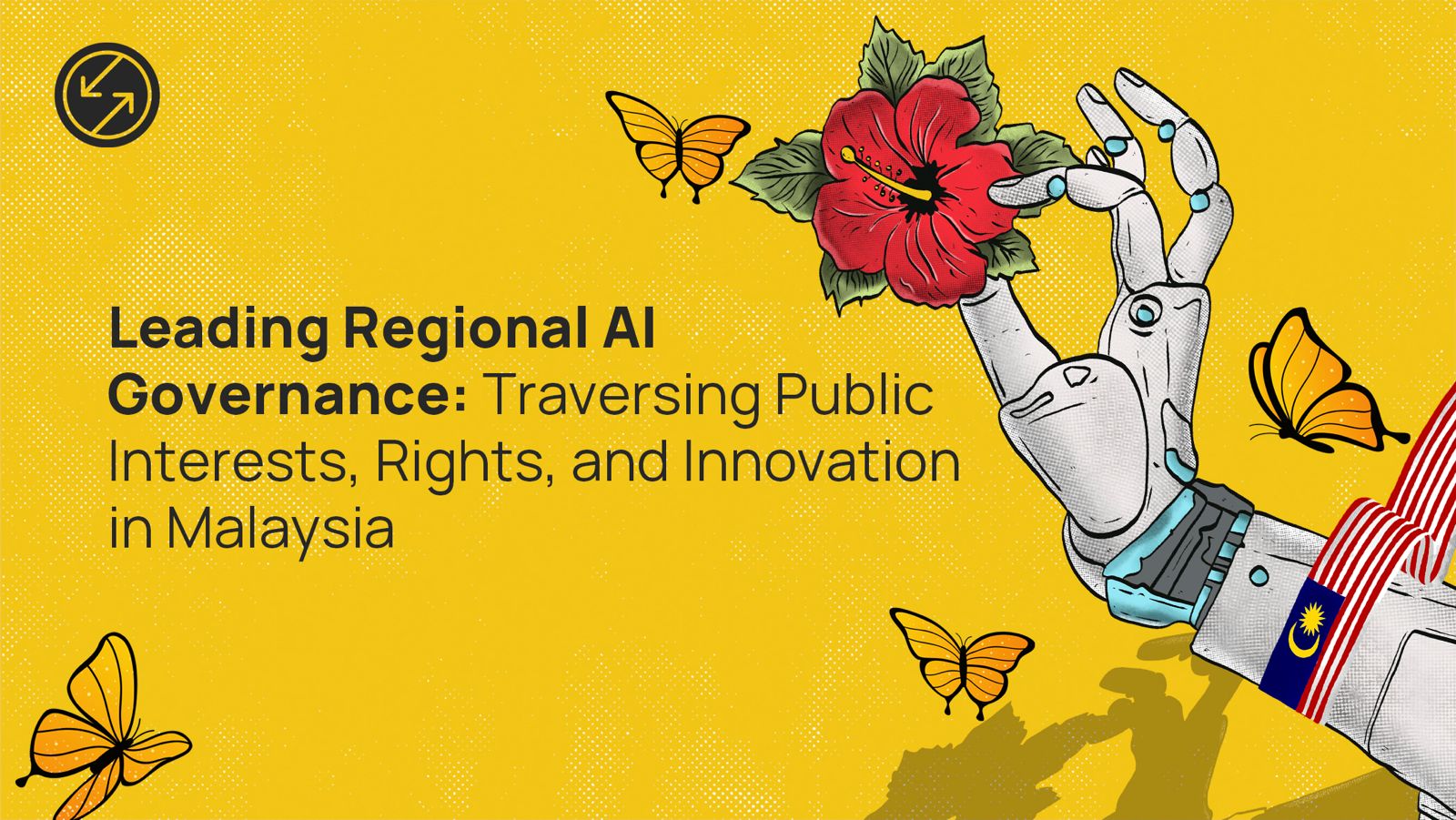
All of these recommendations are further elaborated in the Malaysian Civil Society Position Paper titled Leading Regional AI Governance: Traversing Public Interests, Rights, and Innovation in Malaysia, which highlights issues surrounding AI in the Malaysian context. We hope that the paper can provide nuance and further enrich the discussion on AI governance and accountability. The full text can be found below.