The third edition of the Digital Rights in the Asia-Pacific (DRAPAC) Assembly convened 531 advocates, technologists, researchers, policymakers, and changemakers from at least 25 countries in Kuala Lumpur, Malaysia, from August 26 to 28, 2025. With Malaysia holding the 2025 ASEAN chairmanship, DRAPAC25 also served as a strategic space for safe regional exchanges on digital governance while reinvigorating civil society’s role in upholding respect for fundamental freedoms as Asia-Pacific’s digital futures are being determined.
Building on the successes of DRAPAC23 Chiang Mai in 2023 and DRAPAC24 Taipei in 2024, DRAPAC25 Kuala Lumpur created space for meaningful dialogue and action to protect and advance digital rights across the region.
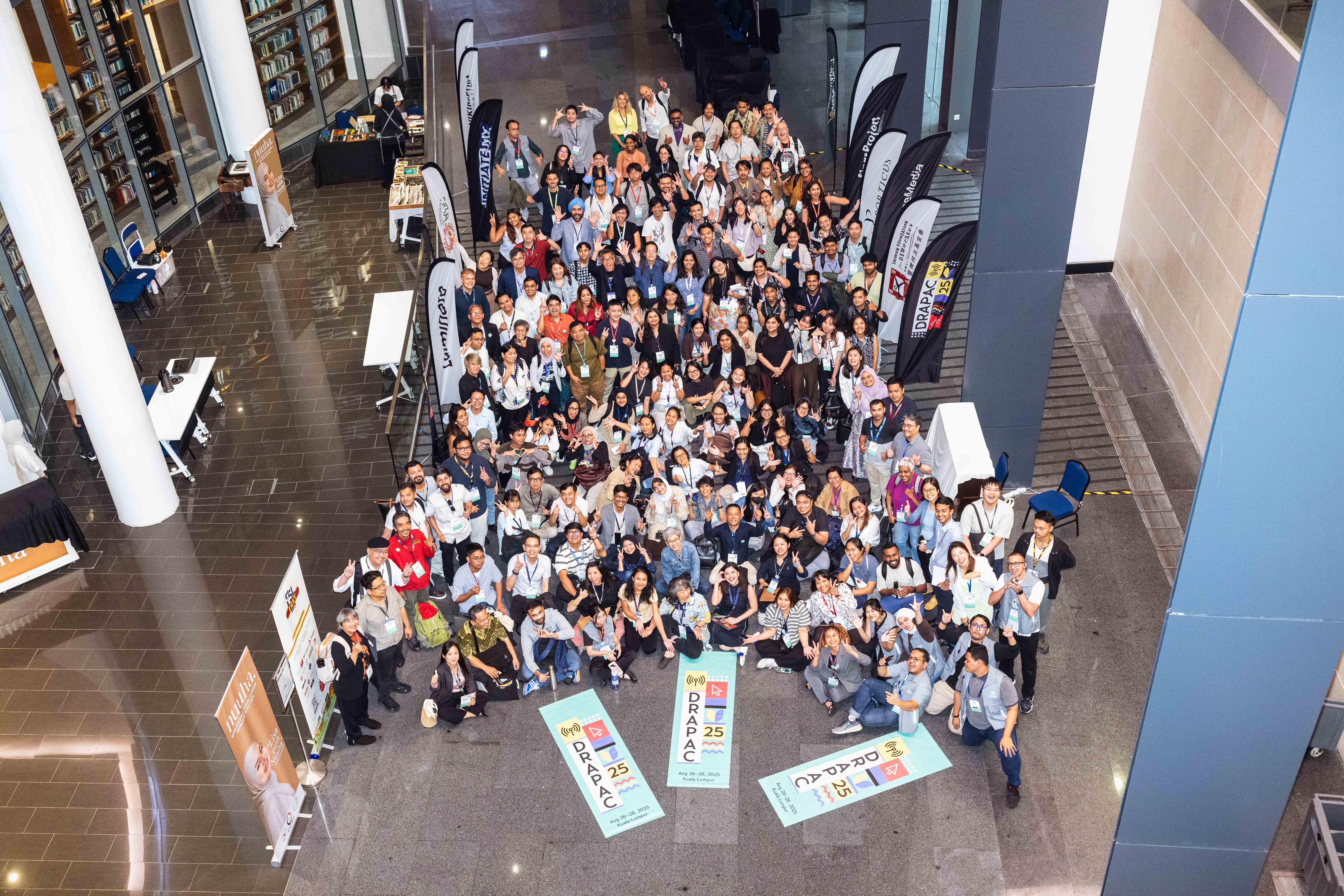
DRAPAC25 Participation: A Community Expanding
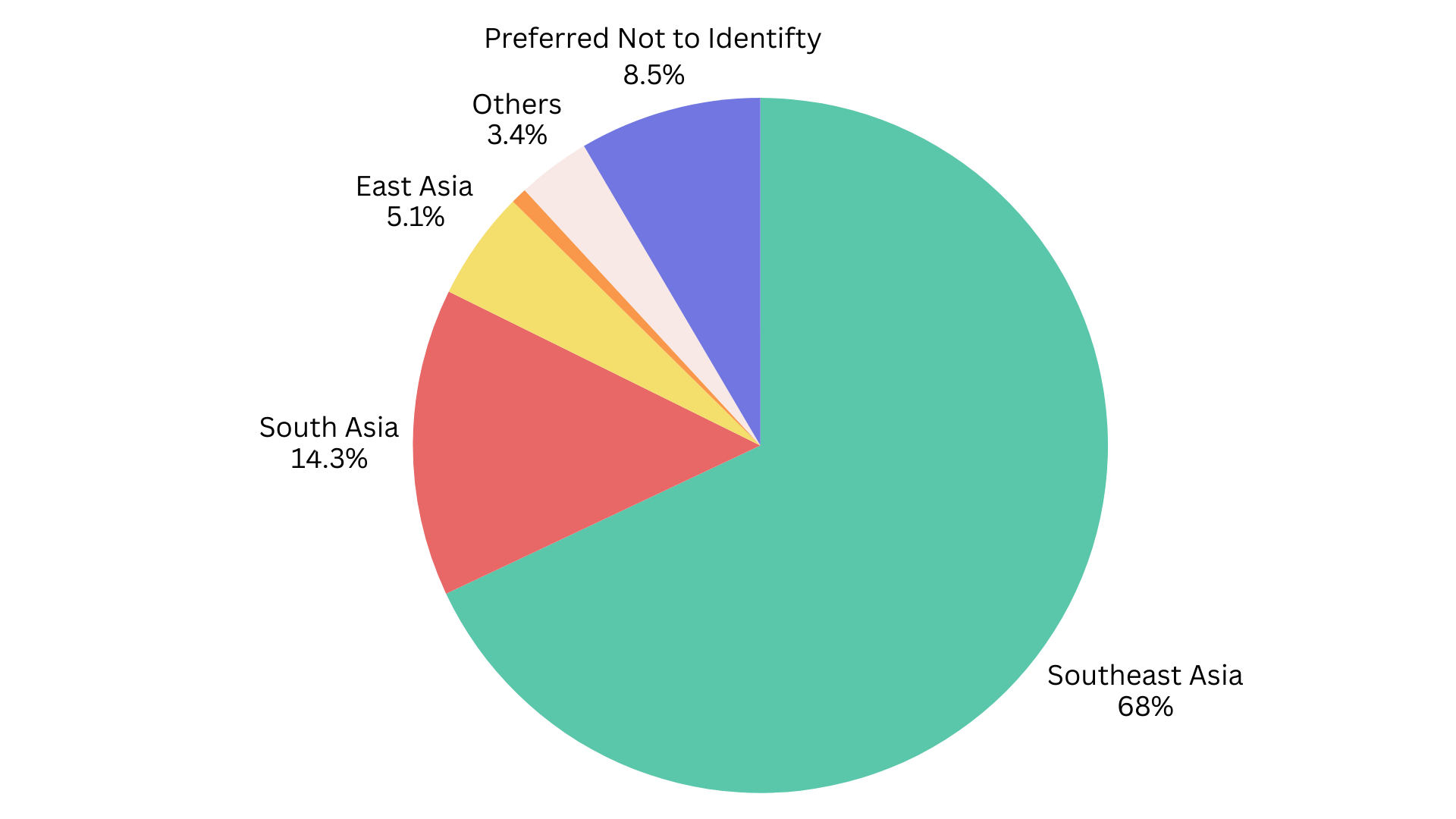
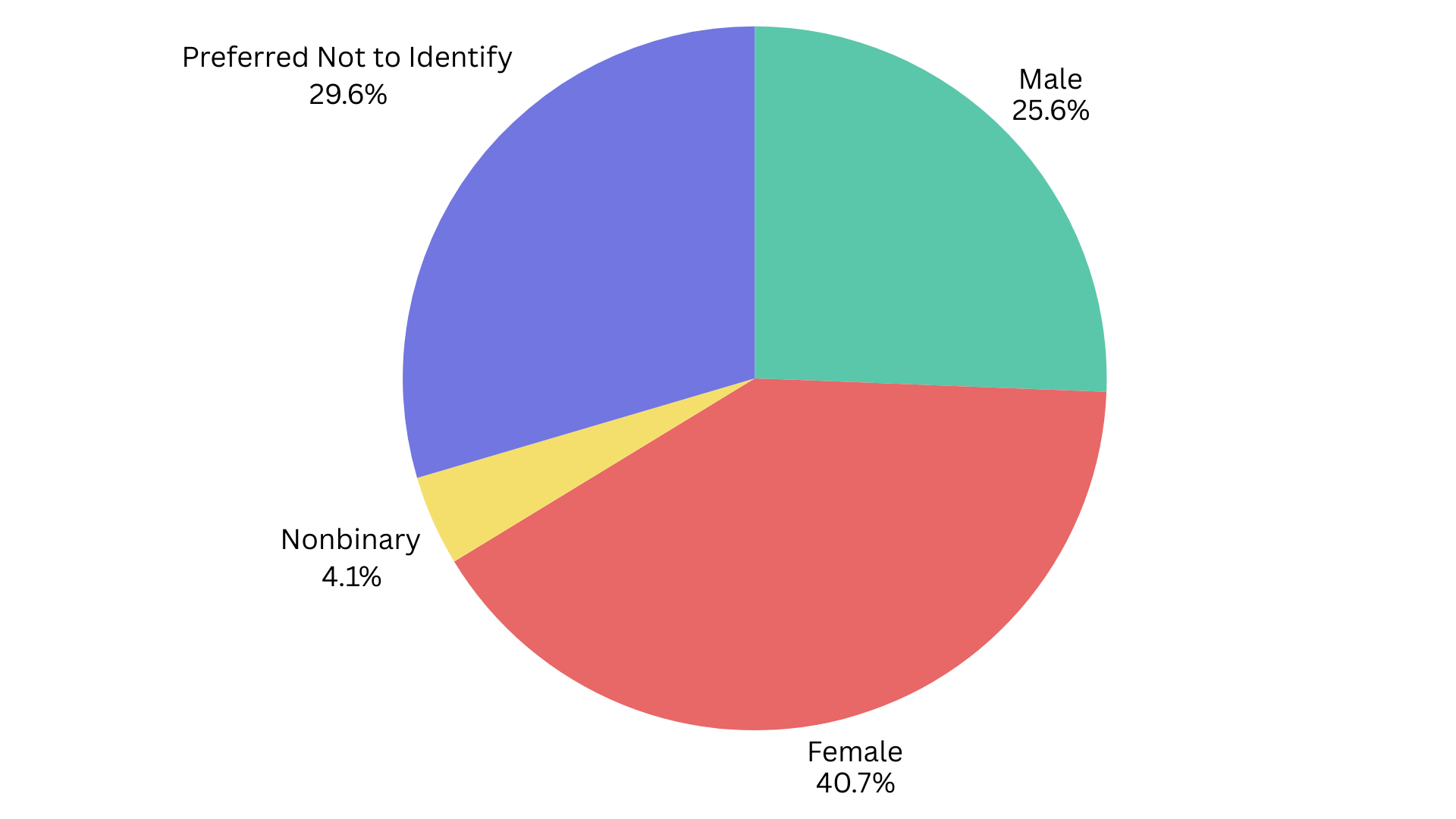
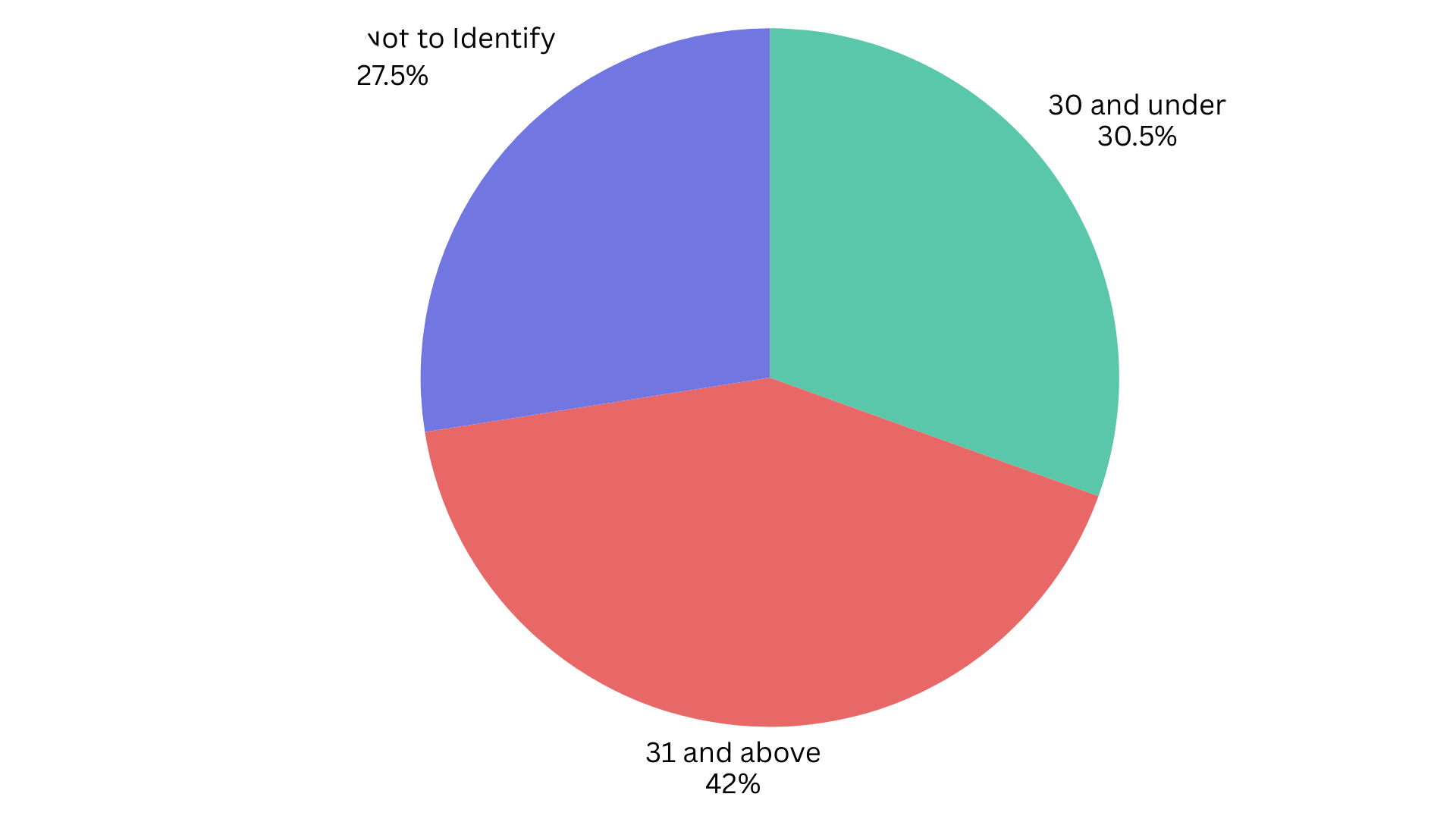
While gender representation remained steady, DRAPAC25 saw an increase in Southeast Asian participation compared to DRAPAC24, as well as a rise in younger participants. Almost 31% of total participants were under 30 years old compared to about 20% last year.
Deepening Intersections: Three Tracks Explored
Together with 200 registered remote participants, the Assembly collectively tackled increasingly complex digital rights issues in more than 100 sessions selected by the DRAPAC25 co-organisers from the over 300 initial session applications. Session selection criteria prioritised relevance, diversity, and representation of marginalised groups, resulting in a programme that covered three thematic tracks, where participants explored different aspects of the movement’s work:
Shaping power, driving change: DRAPAC25 featured sessions that cultivated direct engagement with representatives of governments, businesses, regional institutions, and global fora on topics such as data protection, surveillance and social accountability, AI public governance, and strategic litigation. Here, advocates promoted rights-based digital governance, challenging prevailing power structures and dominant narratives.
Strengthening movements, securing our future: Sessions in this track focused on organisational resilience, digital security, trauma-informed activism, and collective care amid shrinking funding, burnout, and increasing repression that affect the sustainability of defending and upholding digital rights.
Beyond boundaries, beyond limits: Bold solutions were ideated between long-term DRAPAC members and uncommon faces in the digital rights community, such as environmental campaigners, labour organisers, and healthcare workers. Together, they reimagined digital landscapes through interactive art games and the Fediverse, to exchanges about neuro and climate technologies.
Co-Hosting: Broadening Community Leadership
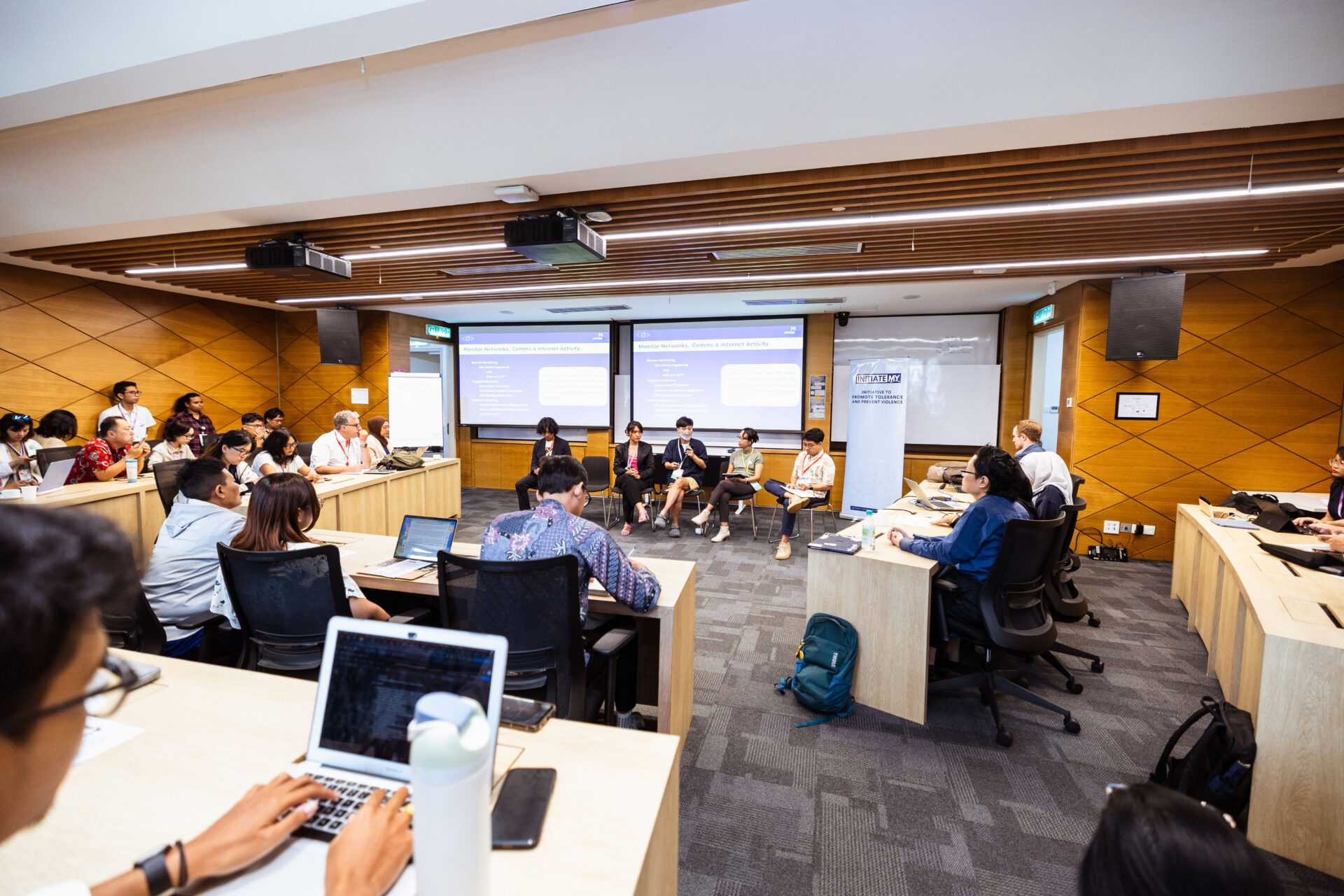
The movement grew in scale while also evolving its convening approach into a new co-hosting model with four Malaysian civil society partners. Alongside EngageMedia, Architects of Diversity (AOD), Centre for Independent Journalism (CIJ), INITIATE.MY, and Sinar Project jointly shaped and steered the Assembly. Beyond expanding convening roles in the region, co-hosting is also an attempt to model shared governance as a movement-building practice, further embodying diverse local realities and diffused power. (Read more about DRAPAC25’s co-hosts.)
Hear from them directly about their experience co-hosting the three-day convening:
As one of the co-hosts of DRAPAC25, this year’s assembly marked an important experiment in collaboration: the first time the conference was co-created by multiple organizations, each bringing distinct expertise to strengthen the curation and impact of the gathering. For Architects of Diversity, our role leaned toward logistical coordination, but in the process, we discovered the art of “unconference” – where the community collectively shapes the agenda, and adaptability becomes a strength.
It was also our first time organising a regional event that expanded our perspectives on democracy and governance in the digital age, and reminded us of the need to engage more deeply in this evolving conversation. Many of the sessions underscored the growing risks to security, privacy, and freedoms – highlighting issues that place civil society at the forefront of safeguarding democratic values and open spaces.
DRAPAC25 opened a new frontier for our work, reminding us that democracy must live not only in systems and participation, but in digital and civic infrastructures that empower people rather than divide them.
The DRAPAC25 program focused on strengthening advocacy on AI governance, cross-border digital trade, and the long-term sustainability of regional digital rights efforts. It also aimed to amplify underrepresented voices and build stronger coalitions to push back against digital authoritarianism in ASEAN.
Our main contribution was through the DRAPAC25 fellowship programme. We co-developed the selection criteria, reviewed applications, and selected fellows. We also helped with pre-event preparation, travel coordination, and onsite mentorship to ensure meaningful participation. In addition, we supported the event through coordinated volunteering to help with logistics and co-created a Rule of Engagement guide outlining how sessions and discussions should be conducted.
The partnership worked well because each organisation brought its own strengths to a shared vision. This alignment made it possible to design a strong program and keep coordination smooth throughout the process. EngageMedia played a central role by maintaining clear communication, sharing resources, and ensuring transparency. Regular check-ins helped the team address any challenges early and keep the planning on track.
One key reflection was the session selection process. Future events should strike a better balance between high-profile speakers and new or emerging voices, including youth and first-time presenters. While there were a few technical issues during the event, they were minor and did not affect the overall flow or experience.
The experience as a co-host added value to the organisation in a few ways in terms of curating participatory and safe spaces. The collaboration created the opportunity to learn from the diverse cultures and experiences of EngageMedia and the other co-hosts. It relatedly reinforced CIJ’s capacity in curating safe spaces of this scale and intensity. The practice of shaping sessions and fellowship criteria, and selection has provided CIJ the opportunity to design similar accessible convenings, both onsite and remotely.
Secondly, locating our work within the regional ecosystem. The importance of having various partners and stakeholders was crucial for us to co-create and inform regional priorities. It helped CIJ’s expansion in perspective and framing of issues. It has also helped us in relationship exploration and building beyond the standard partnerships.
CIJ led two sessions with ARTICLE19 and EngageMedia that highlighted growing conversations on platform accountability and governance. The first session, “Scroll, Post, Delete… But Who’s Responsible?” gathered more than 40 participants to share experiences, map issues, and brainstorm possible governance models. The second was a closed-door workshop that brought together participants and platform representatives to rethink internet safety and accountability in ways that balance rights, safety, and innovation. Both sessions showed strong engagement and a clear appetite for practical, locally grounded solutions.
The experience reaffirmed the importance of partnership in advancing regional digital rights. DRAPAC’s goals align closely with CIJ’s mission, creating space for more collaboration in the future. The networks and trust built through DRAPAC25 will help strengthen advocacy, improve coordination, and promote more inclusive digital governance across the region.
As one of the co-hosts of DRAPAC25, INITIATE.MY is grateful for the opportunity to contribute to such a dynamic and meaningful space. Our involvement spanned across application reviews, risk management, programming, and event design. This experience has not only sharpened our organisational skills but also allowed us to meaningfully shape the discussions on technology-facilitated abuse and its impact on democracy and human security in the Asia-Pacific.
One of the main benefits of this partnership has been the expanded visibility of our work. Through DRAPAC25, we connected with a wider community of practitioners, academics, and advocates across regions—including those from more restrictive contexts—where solidarity and exchange of ideas are especially crucial.
Beyond this, we also learned the value of creating space for participants to share practices from different contexts, whether it was activists from restrictive environments sharing security strategies, or community organisers demonstrating locally rooted approaches to countering online abuse. These exchanges highlighted how solutions to tech-facilitated abuse cannot be one-size-fits-all, but need to be adapted to cultural and political realities. We also saw how participatory formats like the unconference allowed younger or less-established voices to shape the agenda, which is something we can integrate into our own convenings. While the coordination was commendable given the conference’s scale, further streamlining of technical tools such as Slido and Jitsi Meet and communication around slides and session formats could make future sessions even more efficient.
Additionally, we echo the importance of ensuring that co-host partnerships are adequately funded to allow equitable contributions and sustainability. We also see value in involving more gender-focused groups, including those working on SOGIESC issues, to close representation gaps. This would ensure that discussions on tech abuse and accountability are grounded in more inclusive and intersectional perspectives.
Overall, DRAPAC25 has reinforced for us the value of cross-regional collaboration in addressing pressing challenges of tech abuse. The conversations and networks built here are not only a reflection of the conference itself but also part of a larger movement to safeguard democratic values and human rights in the digital age.
As an attendee of DRAPAC since the first edition in Chiang Mai, this was our first time as a co-host. It was amazing to see how the scale of the event has grown, and how many more new people have joined in the digital rights movement in this region. It was a really good opportunity to learn, brainstorm, connect and re-connect. Despite how difficult the issues are and how seemingly little control we have as civil society, it gives a lot of hope when we simply can be in the same room and stand in solidarity against all the big(ger) players. We are thankful to EngageMedia for creating and hosting this platform, and hope that it will continue to bring more ideas and build stronger networks in this space.

Community Insights
Story Cards: Echoes from the Parallel Sessions
EngageMedia distributed story cards during and after the parallel sessions to observe group patterns that provide insight into the value of DRAPAC25 as a shared convening platform.
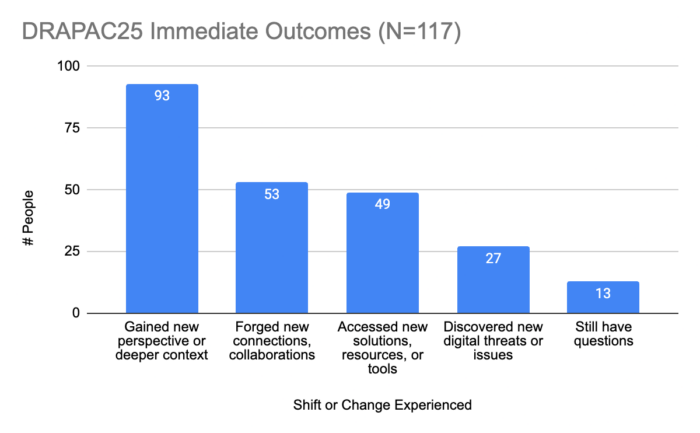
Nearly 80% of 117 story card respondents reported gaining new perspectives or deepening their digital rights understanding. Across over 50 parallel sessions, the story cards reflected community conversations and initiatives around addressing systemic imbalances in technology. Surveillance capitalism, data colonialism and exploitative AI industry practices were recurrent concerns. Solutions were ideated around indigenous data sovereignty, public interest in AI governance, and using creative expression, interactive games, humour, and archiving as powerful tools of resistance and public engagement.
One participant shared, “DRAPAC brought together activists, artists, technologists, and changemakers from across the Asia-Pacific. Walking into those spaces, I felt the richness of diverse voices, people who see the digital world through different lenses but share a common concern for rights, creativity, and justice. For me, it was an eye-opening intercultural experience, and every session pushed me to think in new ways.”
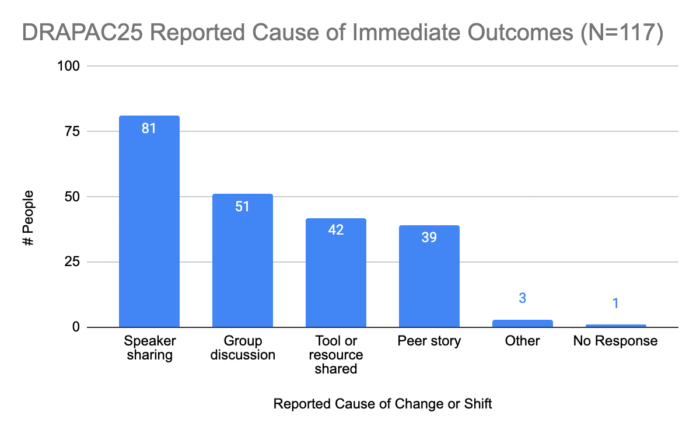
Speakers and locally grounded case studies served as primary learning drivers, with almost 70% of story card respondents attributing positive experiences during the parallel sessions to these factors. Participants also found group sessions and peer exchanges value-adding, with 40% highlighting access to practical tools or resources and translating lessons into concrete next steps through them. Moreover, nearly half (45%) of the respondents reported new connections or emerging collaborations around new solutions.
A fellow expressed, ”What stayed with me was the sense of useful solidarity—the hallway chats, the Tech Fair demos, and the feeling that people were ready to build, not just debate. I’m leaving with concrete next steps: publish my slides and notes openly, co-design that starter kit with new partners, and run small city-level trainings so local evidence can travel faster into policy and storytelling. I’m grateful for the space DRAPAC creates, part classroom, part lab, part family, and I’m excited to carry this momentum home.”
Almost a quarter also surfaced emergent digital threats affecting their work and communities, demonstrating DRAPAC’s role in pushing the boundaries of regional conversations around digital rights, covering neurotechnology risks, posthumous data, and technology effects on climate and indigenous wisdom.
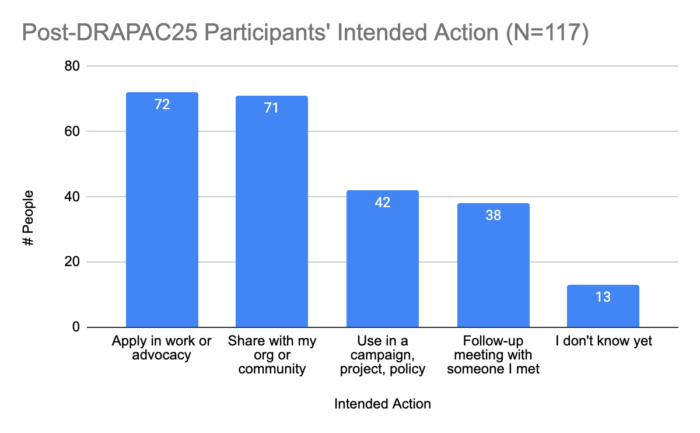
Over 60% of the respondents are planning to share and apply lessons from DRAPAC25 to their respective work, advocacies, and communities. Beyond technical discussions, participants expressed deepening emotional connections grounded in shared struggles, especially among underrepresented voices, but also shared hope for digital justice and resilience to sustain regional collaboration amid shrinking civic spaces.
A participant shared, “The organisers created such an inclusive and empowering space, making me feel supported to speak from the perspective of academia in Timor-Leste and to highlight the barriers women and gender-diverse people face in tech leadership. This was more than just a proud moment; it was a reminder of the responsibility I carry for my community. I’m grateful for every person who made this possible, and I look forward with hope and excitement to joining future DRAPAC assemblies, continuing to grow, share, and build collective digital futures together.”
Footnote: A total of 117 out of over 500 (23%) DRAPAC25 participants contributed through anonymous story cards. The findings cannot be generalized due to limited sample size and convenience sampling.
Connections Map: A Movement in Motion
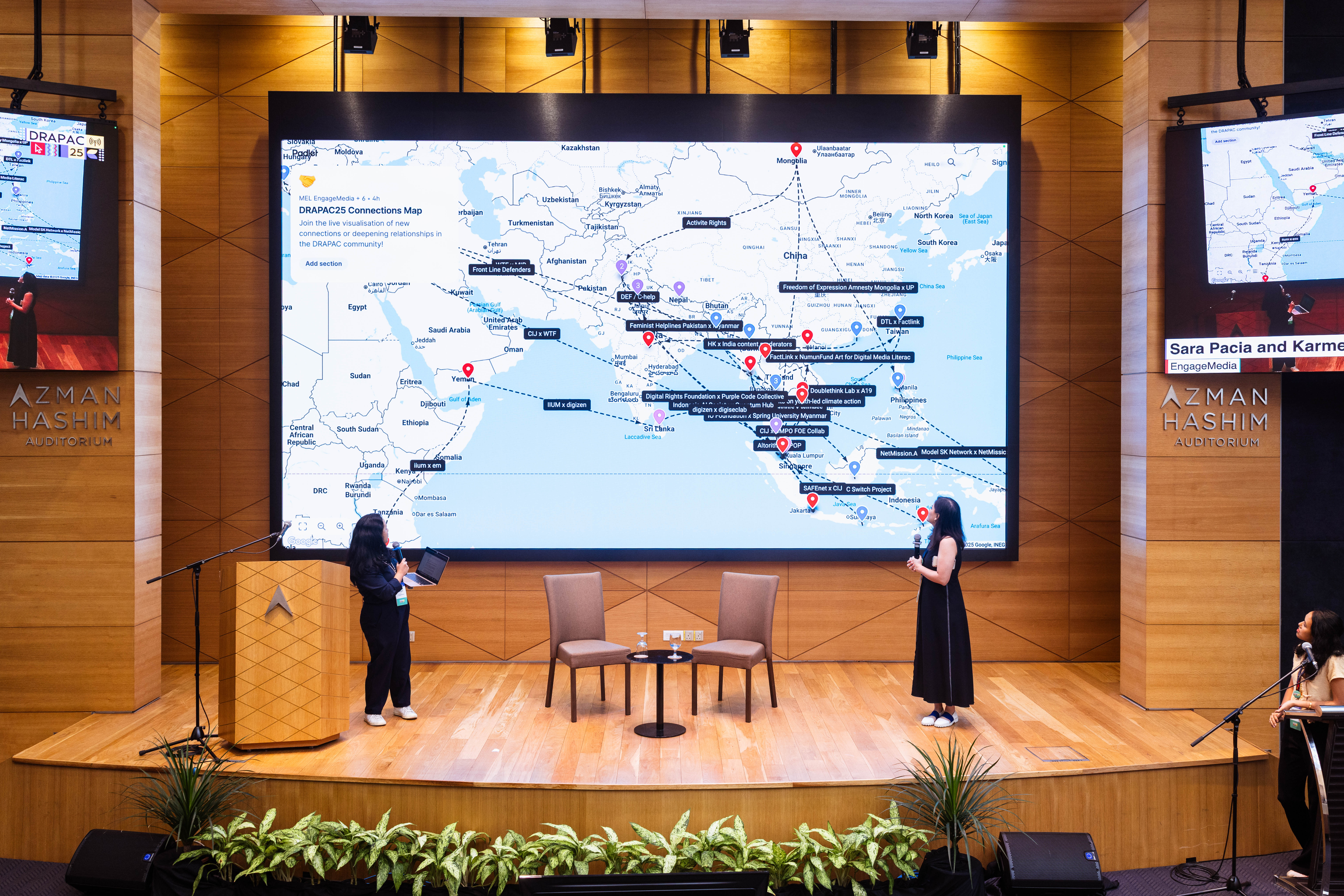
The DRAPAC25 connections map recorded nearly 100 new connections forged across more than 130 organisations from almost 25 countries, marking the rapid expansion of the DRAPAC community. Although Southeast Asia remained the most represented region, new members like Amnesty International from Mongolia, forging at least 3 connections within the first two days of the Assembly, and NetMission.Asia, from Papua New Guinea – participating as the first and so far, only member from the Pacific Islands – signalled widening geographic reach.
Anchoring on DRAPAC’s focus on digital rights, most connections focused on freedom of expression, surveillance, social accountability, and AI governance, alongside more feminist and rights-based perspectives. These demonstrate DRAPAC25’s role in cultivating intersectionality in digital rights advocacy. Beyond these main themes, some participants jointly explored healthcare and environmental research, media literacy, and digital security, while others exchanged insights on more creative alternatives. The diverse focus of connections formed during DRAPAC25 signals that the convening was a safe space for innovation as well as solidarity.
Excitement about these connections centred on collaboration and partnership-building, with new connections, learning, and collective impact among the most frequently cited terms. Participants highlighted the value of regional knowledge exchange, particularly deepening and increasing relationships between South and Southeast Asia to drive collective impact beyond gatherings. Participants expressed enthusiasm for interacting with peers and making new friends, while some shared finding pathways to pursue personal goals, such as opportunities to reconnect in similar convenings like the Digital Citizen Summit and follow-up ideations on how to break away from Big Tech.
Overall, the connections map showed examples of DRAPAC25’s ability to scale its reach while also cultivating meaningful participation, supporting new actors and digital rights-adjacent topics to bring about new areas of collaboration, advocacy, and experimentation, and deepening trust and solidarity among longstanding members.

Movement Voices: Fellow Reflections
From 378 applications, 100 emerging digital rights advocates were selected to contribute their lived experiences, expertise, and fresh perspectives to the DRAPAC community. Below are two fellow highlights that capture transformative experiences from this year’s cohort.
Southeast Asia: Thibi
Thibi’s fellowship journey revolved around connections reflecting curiosity and creativity. Leveraging organisational expertise on data investigation and visualisation, Thibi fellows reported exploring collaborations with at least four DRAPAC members around tackling digital dharma, deepfakes, and experimental storytelling as well as applications of data investigation and visualisation in the DRAPAC25 connections map.

One of the Thibi fellows called for systematic safeguards, platform accountability, and giving power back to the users in her reflection, where she highlighted DRAPAC25 sessions that illuminated policy gaps on digital remains and how the recycling of disinformation content distorts political behavior.
South Asia: Digizen
For Digizen, DRAPAC25 “was more than just a conference; it was a journey of reflection, learning, and connection.” They reflected on three core lessons about AI and data governance as human rights issues shape individual freedoms; how accessible technology upholds dignity; and how collaborations will be unlocked by deepening community connections despite seemingly context-specific challenges. Digizen has begun to move forward with these lessons, as the DRAPAC25 connections map captured a budding partnership with the Digisec Lab on media literacy and digital security.
Beyond DRAPAC25: Towards A Shared Infrastructure For A More Just Digital Future
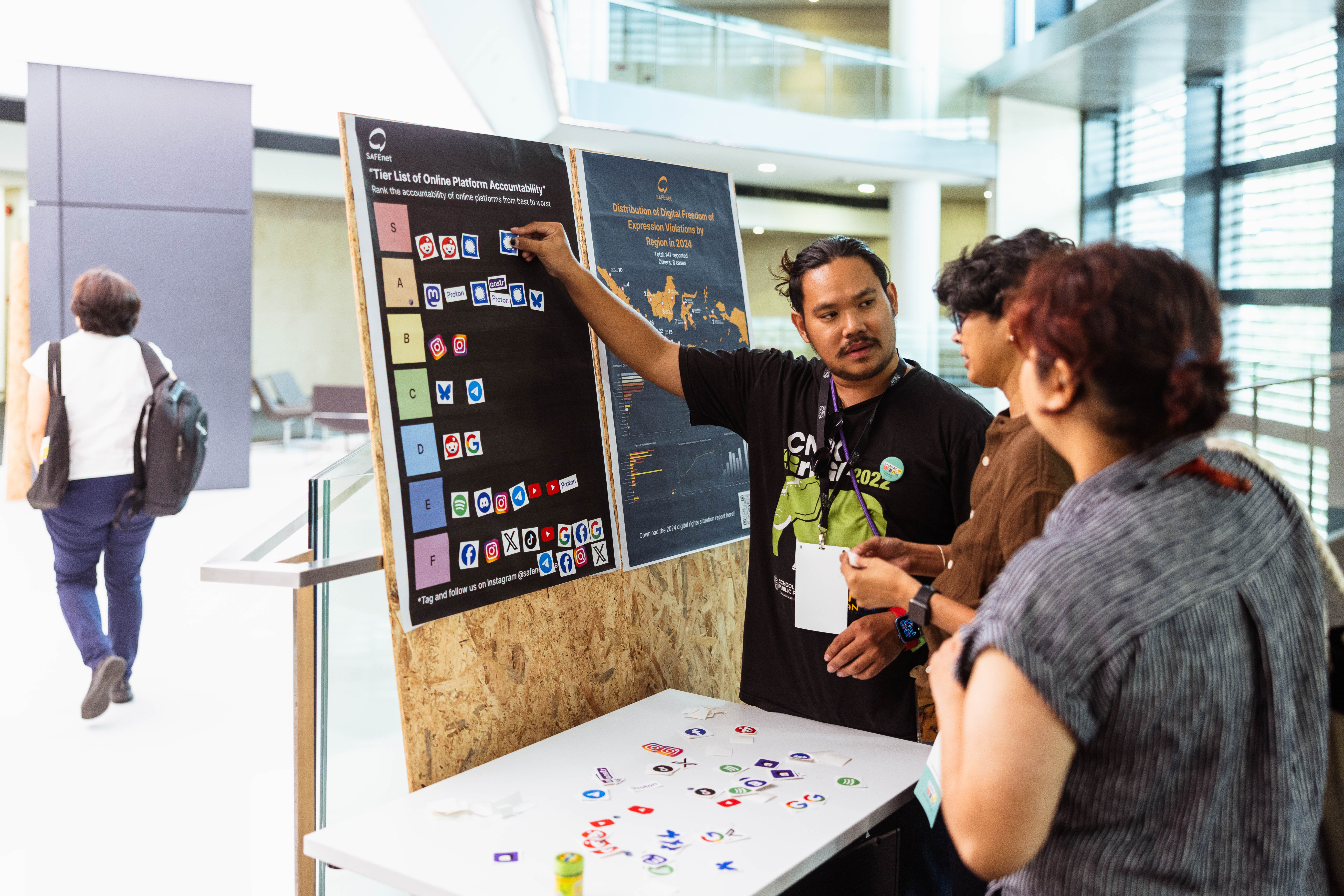
Towards the end of DRAPAC25, the convenors also turned the reflection inward, asking themselves about DRAPAC’s significance in a wider digital rights ecosystem facing funding precarity, shrinking civic space, and increasing fragmentation. In the end, one sentiment echoed clearly: DRAPAC never was a simple annual gathering but a shared infrastructure for Asia-Pacific’s digital rights movement.
Participants described DRAPAC as a space that helps digital rights advocates find each other, bridge gaps in understanding with key decision-makers, and produce co-owned strategic assets, such as shared advocacy tools, community-led research and regional indices, and guidance for frontline defenders – thereby synthesising regional priorities, aligning actions, and building collective power in an increasingly hostile digital environment.
Looking ahead, participants envisioned country-level DRAPAC nodes and micro-communities, widening entry points for emerging actors, grassroots organisations, and those working outside mainstream digital rights circles. To sustain DRAPAC as a living community, participants expressed willingness to contribute in deeply personal ways, such as sharing research, hosting local meetups, mentoring younger advocates, or co-creating regional resources.
Above all, they urged DRAPAC to preserve its defining qualities, characterised by warmth through human connection, accessibility through informality, and creative formats integral to building trust and cultivating openness and cross-collaboration with movements beyond digital rights circles. In a sector constantly under threat of folding, participants affirmed DRAPAC’s role as one of the digital rights community’s vital anchors as a co-owned, human-centred infrastructure that holds space for care, imagination, and collective action toward a more just digital future.